
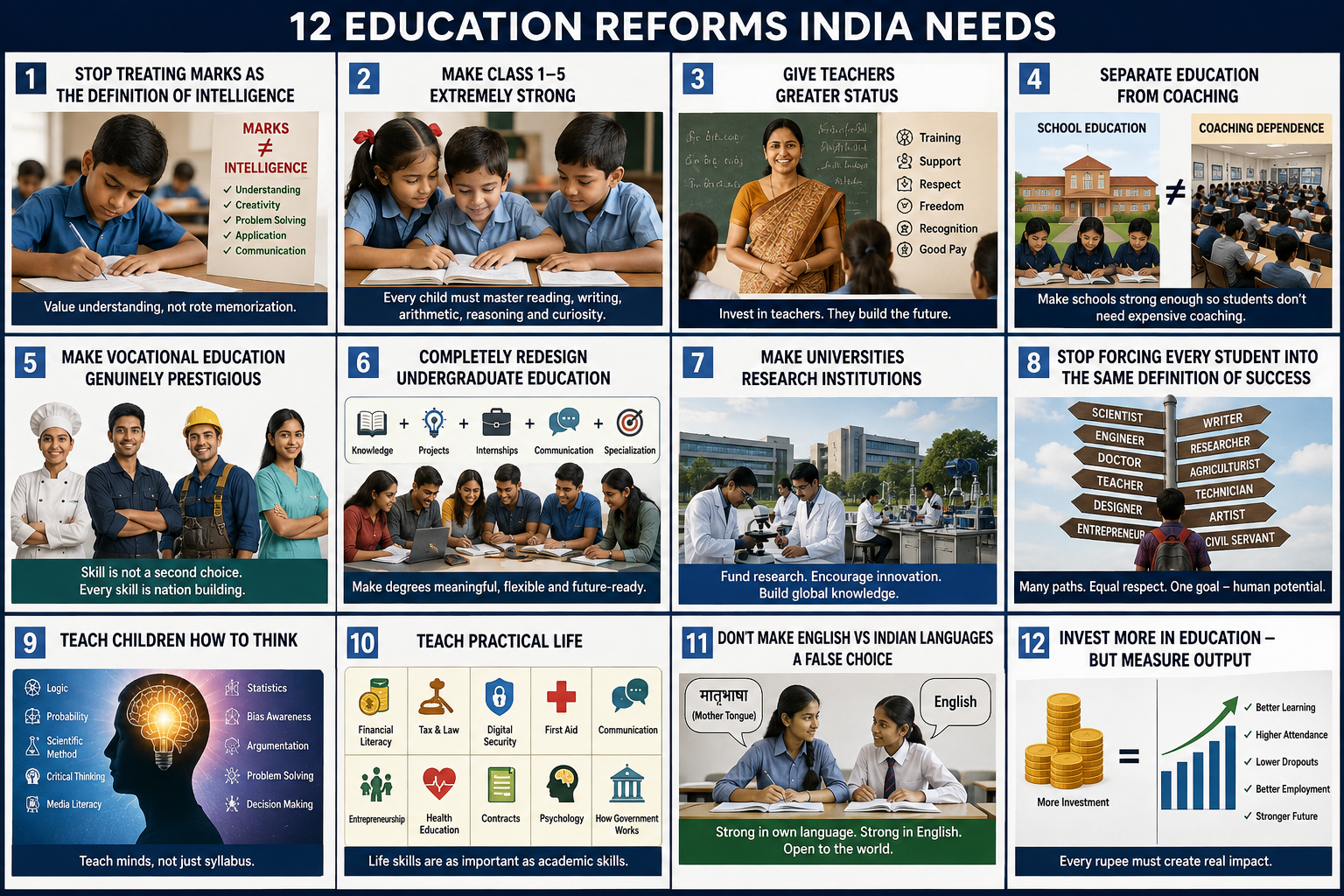
India does not primarily need another education policy. It needs a reform of what education is for, how learning is measured, and how schools and universities are made accountable.
NEP 2020 already identifies many of the right directions—foundational literacy, critical thinking, vocational education, flexible curricula, multidisciplinary higher education and assessment reform. The bigger problem is implementation and incentives.
I would prioritize these reforms:
1. Stop treating marks as the definition of intelligence
The biggest cultural reform should be:
Marks should measure learning, not determine a person’s worth or entire future.
India’s examination system encourages students to optimize for what will appear in the exam, rather than understanding.
Exams should increasingly test:
reasoning
problem solving
application
experimentation
writing and communication
ability to learn independently
conceptual understanding
A student who can solve an unfamiliar problem should be valued more than one who can reproduce 500 memorized answers.
2. Make Class 1–5 extremely strong
This may be the highest-return reform.
Before worrying about coding, AI, IIT preparation or advanced mathematics, every child should reliably acquire:
reading + writing + arithmetic + reasoning + curiosity.
India’s own NEP places foundational literacy and numeracy at the centre of school reform.
The government should publish district- and school-level learning outcomes and intervene where children are falling behind.
3. Give teachers much greater professional status
India should move away from:
> teacher = government employee who completes a syllabus
toward:
> teacher = trained professional responsible for producing learning.
That means:
better teacher preparation
continuous training
fewer irrelevant administrative duties
adequate staffing
transparent performance measurement
freedom to experiment with pedagogy
much better support for teachers in weak schools
And teacher shortages need to be treated as an education emergency, particularly in government schools.
4. Separate education from coaching
This is one of India’s biggest structural problems.
JEE, NEET, UPSC and other competitive examinations have created enormous coaching ecosystems because the stakes of a single examination are so high.
Instead of trying to destroy coaching, India should make the school/university system itself capable of providing competitive-exam-level conceptual education.
A student shouldn’t need to spend ₹2–5 lakh outside school to properly learn physics or mathematics.
5. Make vocational education genuinely prestigious
India needs a culture in which:
electrician ≠ failure
plumber ≠ failure
technician ≠ failure
machinist ≠ failure
A highly skilled technician can be more economically valuable than an unemployed graduate.
NEP 2020 already proposes breaking the rigid separation between vocational and academic education and introducing vocational exposure from school.
But the critical missing ingredient is industry integration.
A student should be able to move:
school → apprenticeship → technician → diploma → engineering degree
without having to restart their education from zero.
6. Completely redesign undergraduate education
India produces enormous numbers of graduates, but a degree often becomes a certificate rather than evidence of capability.
A better bachelor’s programme would contain:
core knowledge + projects + internships + communication + quantitative reasoning + specialization.
And students should be able to change direction.
For example:
> Physics → Computer Science → Semiconductor Engineering
should be possible without losing several years.
This is consistent with NEP’s emphasis on multidisciplinary education and flexible academic pathways.
7. Make universities research institutions—not examination factories
India needs many more universities capable of producing new knowledge, not merely teaching existing textbooks.
That requires:
competitive research funding
research autonomy
strong laboratories
international collaboration
easier hiring of excellent researchers
fewer bureaucratic restrictions
serious PhD training
stronger links between universities and industry
The proposed National Research Foundation was intended to move in this direction.
8. Stop forcing every student into the same definition of success
India has a particularly narrow hierarchy:
IIT/IIM/AIIMS → good
other engineering/medicine → acceptable
everything else → questionable
That’s disastrous for a country of India’s scale.
We need equally respectable pathways for:
scientist
engineer
doctor
teacher
designer
entrepreneur
researcher
craftsman
technician
agricultural specialist
writer
economist
civil servant
skilled tradesperson
The objective should be human capability, not institutional prestige.
9. Teach children how to think
This is perhaps the reform I would personally put at the top.
From perhaps Class 6 onward, students should explicitly learn:
logic → probability → statistics → scientific method → argumentation → cognitive biases → media literacy → economics → basic law → computing.
For example, instead of merely asking:
> “What is the answer?”
students should regularly be asked:
> “How do you know?”
> “What evidence would change your mind?”
> “What assumption are you making?”
> “Can you construct an alternative explanation?”
That creates citizens who can deal with misinformation, propaganda, AI-generated content and complex social problems.
10. Teach practical life
Indian education should teach things that adults actually need:
personal finance
taxation
banking
insurance
basic law and constitutional rights
first aid
digital security
contracts
entrepreneurship
communication
basic psychology
sexual/reproductive health appropriate to age
how government actually works
A student can finish Class 12 knowing trigonometric identities but not understanding a loan agreement.
That’s an educational failure.
11. Don’t make English versus Indian languages a false choice
India should aim for bilingual/multilingual competence, rather than treating English and Indian languages as competing identities.
A child should be able to learn difficult concepts in the language in which they understand them best while also acquiring strong English proficiency.
NEP 2020 itself emphasizes multilingualism and mother-tongue/regional-language instruction in the early years.
The goal should be:
strong mother tongue + strong English + ability to learn additional languages.
12. Put far more money into education—but measure the output
India’s education expenditure remains around 4% of GDP, according to recent reporting based on UNESCO data.
But simply increasing expenditure isn’t enough.
Every additional ₹1,000 should ultimately be connected to measurable outcomes:
Did attendance improve?
Did reading improve?
Did mathematics improve?
Did teacher availability improve?
Did dropout rates fall?
Did employment improve?
Infrastructure is necessary, but a beautiful school where children aren’t learning is still a failed school.
The deeper reform
I think India’s fundamental problem is that its education system has historically been designed around selection rather than development.
It asks:
> “Who is good enough to move forward?”
A modern education system should ask:
> “How do we discover what this person is capable of, and develop it?”
That is a profound change.
And interestingly, India doesn’t need to throw NEP 2020 away to achieve it. Much of the conceptual framework is already there: foundational learning, flexibility, vocational integration, critical thinking, multidisciplinary education and assessment reform.
**The real reform India needs is turning those principles into the everyday experience of a child in an ordinary government school—not merely into policy documents.**